LinkedIn Content Strategy For Small Business Owners (2026): Build Authority Without Writing A Word
By Mike Richards | Published: 3/12/2026
LinkedIn drives 80% of all B2B leads from social media — but most small business owners post inconsistently and give up. Here's what actually works in 2026, what the algorithm rewards, and how to build a consistent presence using nothing but your voice.
LinkedIn Content Strategy For Small Business Owners (2026): Build Authority Without Writing A Word
LinkedIn has over 1.3 billion members and drives 80% of all B2B leads from social media — but most small business owners either don't post at all, or post inconsistently and give up. This guide covers what actually works on LinkedIn in 2026, what the algorithm rewards, and how to build a consistent presence using nothing but your voice.
Quick Answer: An effective LinkedIn content strategy for small business owners in 2026 involves posting 3 to 5 times per week with a mix of short text posts, personal insight posts, and graphics — all built from your existing knowledge and expertise. The fastest way to stay consistent without spending hours writing is to record short audio clips and let a voice-to-content tool like Patric AI convert them into ready-to-post LinkedIn content with graphics. You talk for a few minutes; your LinkedIn presence takes care of itself.
---
If you're a small business owner and you're not showing up on LinkedIn consistently, you're leaving the highest-quality professional audience in social media untouched.
LinkedIn drives between 75% and 80% of all B2B leads generated through social media — far outperforming Facebook, Instagram, and X for professional lead generation. Four out of five LinkedIn members are involved in business decisions. The audience is different from every other platform. People show up on LinkedIn with a professional mindset, actively looking for solutions, services, and experts they can trust.
And yet most small business owners either don't post at all, or post sporadically and stop when they don't see instant results.
The gap isn't interest — most business owners understand LinkedIn matters. The gap is time and consistency. Writing professional-sounding LinkedIn posts multiple times per week is genuinely hard when you're also running a business. This guide covers how to close that gap: what to post, how often, what the algorithm actually rewards in 2026, and how to build a consistent LinkedIn presence by talking rather than writing.
---
Table of Contents
---
Why LinkedIn Is The Most Valuable Platform For Small Business Owners
Not every platform is worth your time. For small business owners — especially those in professional services, B2B, consulting, trades, health, finance, real estate, or any field where trust and expertise matter — LinkedIn has a specific and powerful advantage: the audience is already in a buying mindset.
On Instagram, people are looking at food, travel, and entertainment. On Facebook, they're catching up with family and friends. On LinkedIn, they're thinking about work, business challenges, and professional growth. When your content appears in that context, it lands differently. A short post about a common mistake your clients make, or a lesson from a recent project, is genuinely relevant to what your audience is already thinking about.
Only 3% of LinkedIn users post more than once per week. That means the competition for attention is dramatically lower than on Instagram or Facebook, where everyone is trying to be a content creator. The business owner who shows up consistently on LinkedIn with useful, genuine content has an outsized advantage over the 97% who are just watching.
The engagement numbers reflect this. LinkedIn's average engagement rate across all content is 3.85%, up 44% year-over-year — and that's the average, not the ceiling. For small business owners posting relevant, expert-level content to a targeted professional audience, the engagement rates can be significantly higher.
---
What The LinkedIn Algorithm Actually Rewards In 2026
LinkedIn's algorithm changed significantly in late 2025, and strategies that worked even 12 months ago no longer perform the same way. Understanding what the algorithm rewards now determines whether your content gets seen or buried.
Relevance over reach. The 2026 LinkedIn algorithm prioritizes showing content to the right people over showing it to the most people. A post about HVAC maintenance tips reaching 500 HVAC buyers is more valuable than a generic business post reaching 5,000 people who have no connection to your industry. Niche content consistently outperforms broad content, because the algorithm can identify specific topics and serve them to exactly the right audience.
Engagement depth over engagement volume. Likes still count, but LinkedIn now pays closer attention to comments, saves, and shares — signals that indicate someone found the content genuinely useful rather than just mildly interesting. LinkedIn comments increased 37% year-over-year as the platform shifts toward conversation over passive scrolling. Posts that spark real discussion stay in feeds for two to three weeks rather than disappearing in 24 hours.
Personal profiles over company pages. Organic posts from company pages now reach only about 1.6% of their followers. Personal profiles generate dramatically more reach — up to five times more — than company pages. For small business owners, this is actually great news: your personal profile, built around your expertise and personality, is your most powerful LinkedIn asset.
Human authenticity over polished corporate content. LinkedIn in 2026 rewards real perspective, genuine stories, and specific expertise. The algorithm is now better at detecting low-quality AI-generated content and deprioritising it. Posts that share an honest opinion, a lesson from a real project, or a perspective that only you could offer consistently outperform generic tips and recycled advice.
Consistency over virality. No single viral post builds a LinkedIn presence. Consistent, regular posting over months is what grows a following, builds trust, and generates inbound leads. The algorithm rewards accounts that show up regularly by distributing their content more widely.
Personal Profile vs Company Page: Where To Focus
For small business owners, the answer is clear: your personal profile first.
Company pages are worth maintaining — they serve as a professional home base that potential clients will check when researching your business. 40% of LinkedIn users interact with business pages every week, mostly to verify that a business is legitimate and active. Keep it updated and post occasionally. But don't expect company page posts to drive significant organic reach.
Your personal profile is where LinkedIn authority is actually built. People connect with people. When a potential client sees a post from a real person sharing genuine expertise, they engage. When they see a branded company post, they scroll past.
The most effective LinkedIn strategy for a small business owner in 2026 is a strong personal profile — your photo, a clear headline that explains who you help and how, a well-written about section — combined with consistent personal posting from that profile. Your company page supports your credibility; your personal profile does the actual work.
If you have staff, encourage them to engage with and share your posts from their own profiles. Employee engagement dramatically extends the reach of your content, because each person's network sees it as a personal recommendation rather than a brand broadcast.
---
How Often To Post On LinkedIn (The Research-Backed Answer)
For small businesses with one to ten employees, the recommended posting frequency is two to three times per week, with a focus on the founder's voice and behind-the-scenes content. For founders or solopreneurs aiming for stronger authority growth, three to four high-quality posts per week is the sweet spot.
Buffer's analysis of over two million LinkedIn posts found that moving from one post per week to two to five posts per week produces a significant lift in per-post reach and engagement. Each step up in frequency delivers better results — LinkedIn doesn't penalise you for posting more, it rewards it, as long as the quality stays consistent.
One important caveat: don't post more than once per day. Accounts posting twice or more daily see a median drop in reach per post of over 40%. LinkedIn needs time between posts to distribute each piece of content before the next one competes with it for attention.
The practical target for most small business owners: three posts per week. That's enough to stay consistently visible, build the algorithm's trust in your account, and give each post time to breathe. If that feels like a lot, remember that with a voice-to-content workflow, three posts per week requires about fifteen minutes of talking spread across the week.
---
The Best Content Formats For Small Business LinkedIn Posts
Not all LinkedIn post formats perform equally. Here's what the data shows for 2026.
Text posts with an image or graphic. The workhorse format. A short, punchy post — typically 150 to 300 words — paired with a relevant graphic performs consistently well across all industries. Custom image posts with two to four images see 2x higher comment rates than single images. Posts with graphics that look native to LinkedIn (not generic stock photos) consistently outperform text-only posts.
Carousel posts (PDF documents). Carousel posts achieve the highest average engagement rate of any LinkedIn format at 6.60% — 278% more than video and 596% more than text-only posts. A carousel is a swipeable document where each slide delivers one insight, tip, or point. They work especially well for "how to" content, step-by-step processes, and lists.
Native video. Video views on LinkedIn grew 36% year-over-year, and LinkedIn is investing heavily in video features. Short, natively uploaded videos — speaking directly to camera or showing something relevant to your work — perform well because they're rare from small business owners. The bar is low: a genuine 60-second clip from your phone outperforms a polished corporate video because authenticity is what the LinkedIn audience responds to.
Personal story posts. Posts that share a lesson learned, a mistake made, a project win (or loss), or a genuine observation from your work tend to generate the highest comment volumes. Posts about failures and lessons learned consistently outperform success stories in terms of engagement, because they're relatable and human in a feed full of polished self-promotion.
Polls. LinkedIn polls achieve 6 to 12% engagement rates — among the highest of any content format. A simple poll question relevant to your industry generates votes, comments, and shares while providing useful data about what your audience cares about. Use them sparingly (once every few weeks) to avoid the format feeling gimmicky.
---
What To Post: Content Ideas That Build Authority And Trust
Knowing what format to use is only half the challenge. Knowing what to actually say is where most small business owners get stuck.
The most effective LinkedIn content for small business owners falls into four categories.
Expertise posts. Share something specific you know that your potential clients don't. This isn't generic industry advice — it's the insight that comes from your specific experience. A plumber talking about the three things homeowners do that make small leaks turn into major ones. An accountant explaining the expense category that gets the most clients into trouble at tax time. A fitness trainer describing why most people who fail at getting results make the same mistake in their first two weeks. Your expertise is the content. You just have to say it out loud.
Behind-the-scenes posts. Show what a day in your work actually looks like. Not the polished version — the real version. The job site at 7am. The client call that went in an unexpected direction. The problem that came up and how you solved it. This type of content builds familiarity and trust in a way that polished marketing content cannot. People want to know the person they're considering hiring, and behind-the-scenes content is how they get to know you without meeting you in person.
Client wins and case studies. Describe a specific client situation, challenge, and outcome — without names if necessary. "A client came to us with [problem]. Here's what we found, what we did, and what happened." This format demonstrates competence and builds social proof more effectively than any testimonial, because it shows your thinking process in action, not just the end result.
Opinions and takes. Share your genuine view on something in your industry. Disagree with a common belief. Point out something that's changed. Call out a trend you think is overrated or underrated. Opinion-based content generates more comments than any other type because it invites people to respond. You don't need to be controversial — you just need to have a real perspective and express it clearly.
For more on generating a consistent supply of content ideas, check out the 5 minutes a day content marketing strategy — many of the same topic-generation principles apply directly to LinkedIn content.
---
The Voice-First LinkedIn Workflow: Talk Instead Of Write
Here's the problem most small business owners run into: they understand LinkedIn matters, they know roughly what to post, but they can't sustain the habit of sitting down and writing three posts a week while also running a business.
The solution is to remove writing from the equation entirely.
Patric AI converts your voice recordings into finished LinkedIn posts with graphics, automatically. You record a few minutes of audio — talking about a client situation, a lesson from your week, a tip from your expertise — and Patric generates a complete LinkedIn post with a graphic, formatted and ready to publish.
The workflow looks like this: pick a topic (a question a client asked you this week, something that happened on a job, an observation about your industry). Talk about it for two to three minutes. Upload the audio or record directly on the Patric AI website. Your LinkedIn post — with a graphic — is ready.
Three posts a week this way requires about ten minutes of talking total. Compare that to the hour or more it takes most people to write three posts from scratch, and the maths are clear. As covered in the article on how to create blog content by just talking, speaking is three times faster than writing — and the output is more natural and authentic because you're not trying to sound like a writer.
This authenticity matters specifically on LinkedIn in 2026. The platform's algorithm is actively deprioritising generic, polished content in favour of genuine human perspective. Content that sounds like you — because it literally came from you talking — performs better than content that was carefully drafted to sound professional.
The same recording that generates your LinkedIn post also becomes a blog article and a podcast episode through Patric AI. Three formats, multiple platforms, from one short recording. That's the complete minimum viable content marketing system for a small business owner — and LinkedIn is one of the highest-leverage places to deploy it.
---
When To Post: The Best Days And Times
Timing matters on LinkedIn more than on most platforms, because the algorithm uses early engagement in the first hour to determine how widely to distribute a post. A post that gets strong early engagement gets shown to more people. A post that sits quietly for the first hour gets buried.
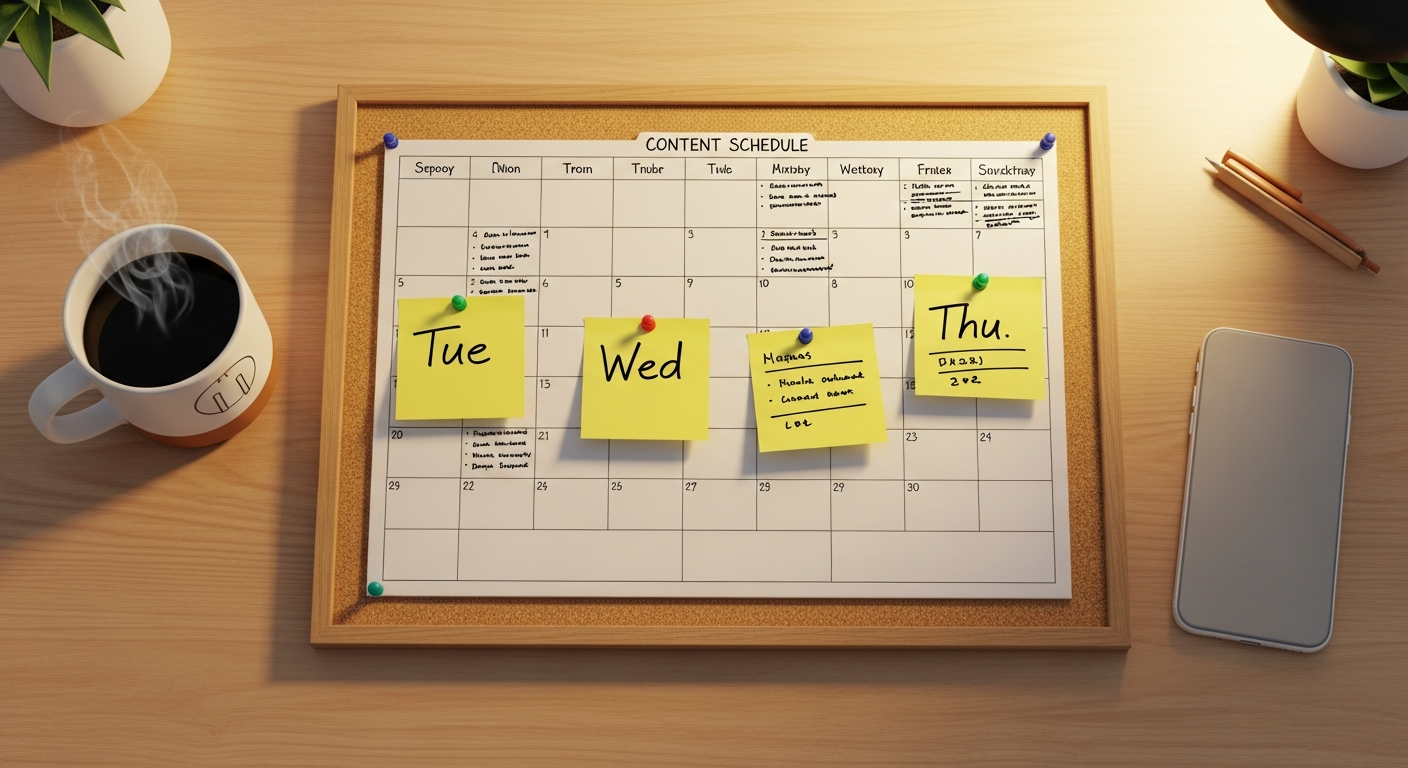
Tuesday, Wednesday, and Thursday consistently show the highest engagement across LinkedIn data in 2026. Tuesday is typically the strongest single day. Monday and Friday can work, but professionals are often in planning mode on Monday and mentally checked out by Friday afternoon.
For timing within the day, the 10am to 11am window in your audience's local time zone shows the most consistent peak engagement, according to multiple data sources including Sprout Social and Buffer. A secondary window around 4pm to 5pm also performs well, as professionals wrap up work and do a final scroll through their feed.
The practical schedule for a small business owner posting three times per week: Tuesday morning, Wednesday or Thursday morning, and one afternoon post mid-week. Consistency on this schedule for two to three months will tell you how your specific audience responds, and you can refine from there.
Common LinkedIn Mistakes Small Business Owners Make
Only posting about their products or services. LinkedIn users scroll past overt self-promotion at a high rate. The rule of thumb most successful LinkedIn creators use is roughly four to five value-led posts for every direct promotional post. Lead with expertise; let the audience draw their own conclusions about whether to hire you.
Posting from the company page only. As covered earlier, company page organic reach is severely limited. Personal profile content reaches far more people and builds far more trust. If you're only posting from your business page, you're starting with a significant reach disadvantage.
Writing posts that link to external content in the body. Every external link in a LinkedIn post reduces initial reach by approximately 30%, because LinkedIn's algorithm deprioritises content that drives users off the platform. If you want to share an article or link, put it in the first comment rather than the post itself.
Posting once, not seeing results, and stopping. LinkedIn authority builds slowly. The first month of consistent posting typically produces modest results. Month three looks meaningfully different. Month six often produces inbound enquiries without any active outreach. The business owners who stop after a few weeks of low engagement are quitting right before the compounding starts.
Using too many hashtags. More than three to five hashtags makes posts look spammy and gets them deprioritised by the algorithm. Use three to five focused hashtags that are directly relevant to your topic and audience.
Ignoring the comments section. LinkedIn rewards posts with high comment engagement. Responding to every comment in the first hour after posting signals to the algorithm that the conversation is active, which extends distribution. The comments section is also where relationships actually form — not in the feed.
---
Frequently Asked Questions
Do I need a large following to get results on LinkedIn?
No. LinkedIn's algorithm serves content based on relevance and engagement quality, not just follower count. A business owner with 500 focused connections in their target industry can generate more qualified leads than an account with 10,000 loosely connected followers. Start posting to whoever is in your network now. Engaged posts get shown to second and third-degree connections, which gradually grows your reach organically.
Should I be posting as myself or as my business?
Both, but prioritise your personal profile. Your personal posts should reflect your expertise, personality, and genuine perspective. Your company page posts can cover business updates, case studies, and more formal announcements. The personal profile does the relationship-building work that drives inbound leads; the company page provides the professional credibility check that converts interested readers into enquiries.
What if my industry isn't traditionally active on LinkedIn?
Test it before assuming. LinkedIn has over 1.3 billion members across virtually every industry, including trades, home services, food and hospitality, fitness, and retail — not just tech and finance. The 3% of users who post actively have a visibility advantage regardless of industry, because they're the ones showing up in a space where their competitors are silent. Even a modest consistent presence in a less saturated industry niche can produce significant results.
How do I handle negative comments or pushback on LinkedIn?
Respond professionally and calmly. Disagreement in the comments is actually a positive signal to the LinkedIn algorithm — it indicates the post sparked genuine engagement. Thank people for their perspective, share your reasoning, and keep the exchange respectful. Never delete legitimate critical comments, as it damages trust with your wider audience. The only comments worth removing are spam or genuinely abusive ones.
How long before LinkedIn content marketing produces real results?
Expect to post consistently for two to three months before seeing meaningful follower growth or inbound enquiries. The first month is about establishing the habit and learning what resonates with your specific audience. By month three, the compounding effect of consistent posting typically starts producing visible results. Most small business owners who stick with a consistent LinkedIn strategy for six months report it becoming one of their most valuable lead generation channels — without any paid advertising. Consistency is the variable that determines success more than any other factor, which is why reducing the friction of content creation is the most important thing you can do.
Can I repurpose the same content across LinkedIn and other platforms?
Yes, with adaptation. The same core insight can be shared across LinkedIn, Facebook, Instagram, and X — but the format and tone should match each platform. LinkedIn favours professional, insight-led content. Instagram favours visual, punchy posts. A voice-to-content tool like Patric AI handles this automatically, generating platform-specific posts from a single recording so you're not manually reformatting the same content four times.
---
LinkedIn is the one social media platform where showing up consistently with genuine expertise almost always produces business results. The audience is professional, the competition for attention is low (only 3% of users post regularly), and the algorithm actively rewards authenticity and relevance.
The barrier for most small business owners isn't understanding — it's time. If writing three LinkedIn posts a week feels unsustainable, try talking them instead. Record your expertise, your client stories, your industry observations — and let the content take care of itself.
Start building your LinkedIn presence today at Patric AI. Record once, publish everywhere.