5 Minutes A Day: The Minimum Viable Content Marketing Strategy For Small Business Owners (2026)
By Yaro Joseph | Published: 3/10/2026
You don't have an hour a day for content marketing. This guide shows you how five minutes of talking can become a week of content across your blog, podcast, and social media — automatically.
5 Minutes A Day: The Minimum Viable Content Marketing Strategy For Small Business Owners (2026)
You don't have an hour a day for content marketing. Most small business owners don't. But here's the thing: you don't need one. This guide shows you how five minutes of talking can become a week of content across your blog, podcast, and social media — automatically.
Quick Answer: The minimum viable content marketing strategy for a small business owner is one 5-minute audio recording per week. Using a voice-to-content tool like Patric AI, that single recording becomes a blog article, a podcast episode, and social media posts with graphics for LinkedIn, Facebook, Instagram, and X — all distributed automatically. You don't need to write, edit video, or learn any new technology. You just need to talk.
---
Most small business owners know they should be doing content marketing. The evidence is overwhelming. Content marketing generates over three times as many leads as outbound marketing and costs 62% less. Businesses that blog consistently get 434% more indexed pages than those without a blog, which compounds into dramatically more organic traffic over time.
And yet, most small business owners aren't doing it consistently — or at all.
The reason isn't laziness. In a typical year, 65% of small business owners struggle with either budget limitations or lack of time for marketing, according to Constant Contact's research. Over 54% say they struggle to produce enough content to support multiple social media channels. Time is the constraint. Not effort, not intention.
The conventional advice — "build a content calendar," "batch record a month of content," "hire a social media manager" — assumes you have time and money you don't have. This article takes a different approach: what's the absolute minimum that actually moves the needle, and how do you do it in five minutes a day?
---
Table of Contents
---
Why Most Small Business Content Strategies Fail Before They Start
There's a specific pattern that plays out for most small business owners who try to start content marketing.
They read an article or watch a video about how powerful content marketing is. They get motivated. They decide to start a blog, or a podcast, or get serious about social media. They download a content calendar template. They brainstorm a list of topics. They might even write one or two posts.
Then the business gets busy — a project deadline, a difficult client, an unexpected problem — and the content stops. A week goes by. Then a month. The momentum is gone, and starting again feels harder than starting the first time.
47% of podcasts stop after fewer than three episodes, a pattern so common it has its own name: podfade. The same attrition happens with blogs and social media accounts across every industry.
The problem isn't motivation. The problem is that the strategy required too much time and complexity to maintain when life got in the way. The solution isn't more motivation. It's a simpler strategy.
Nearly 80% of small business owners write their own marketing content, according to Semrush. Without AI tools, 38% of those marketers say it takes two to three hours to write a single long-form article. That's two to three hours for one blog post — not including social media, not including formatting, not including graphics. For someone running a business alone or with a small team, that's not a sustainable workflow.
The minimum viable approach strips content marketing down to what's genuinely sustainable at the smallest scale: one recording, once a week, five minutes long.
---
The Minimum Viable Content Marketing Strategy
The concept of a "minimum viable product" in software development means building the smallest version of something that still delivers real value. The same thinking applies to content marketing.
The minimum viable content marketing strategy has three requirements:
It has to be fast enough that you actually do it. It has to produce content across multiple channels, because showing up in one place isn't enough in 2026. And it has to be sustainable for months and years, not just weeks.
A five-minute audio recording hits all three requirements — but only if you have the right system to turn it into distributed content automatically. Recording audio and then manually turning it into a blog post, then manually creating five social media graphics, then manually uploading to a podcast feed, would take hours. The whole point collapses.
The system that makes five minutes actually work is a voice-to-content tool like Patric AI. You record your audio — directly on the website or by uploading a file — and Patric transforms it into a formatted blog article, a podcast episode, and social media posts with ready-to-use graphics for LinkedIn, Facebook, Instagram, and X. One recording, multiple channels, zero additional work.
That's the minimum viable content marketing strategy. Let's break down exactly what it produces.
---
What Five Minutes Of Talking Can Produce
Five minutes of audio is more content than most people realize. Speaking at a natural conversational pace of around 130 words per minute, five minutes produces roughly 650 words. That's enough for a genuine, useful blog article. It's enough for a substantive podcast episode. It's more than enough for compelling social media posts.
Now consider what ten minutes produces: around 1,300 spoken words, which Patric AI expands into a fully structured blog article of approximately 2,000 words — the kind of in-depth post that performs well in both Google search and AI-generated answers. Without AI tools, 38% of marketers say it takes two to three hours to write a single long-form article, according to Semrush research. Ten minutes of talking gets you the same result. Not a rough draft you still need to spend three hours polishing — a finished, formatted, publishable article.
That's the exchange rate worth internalising: ten minutes of speaking equals what would have taken most people a full work morning to write.
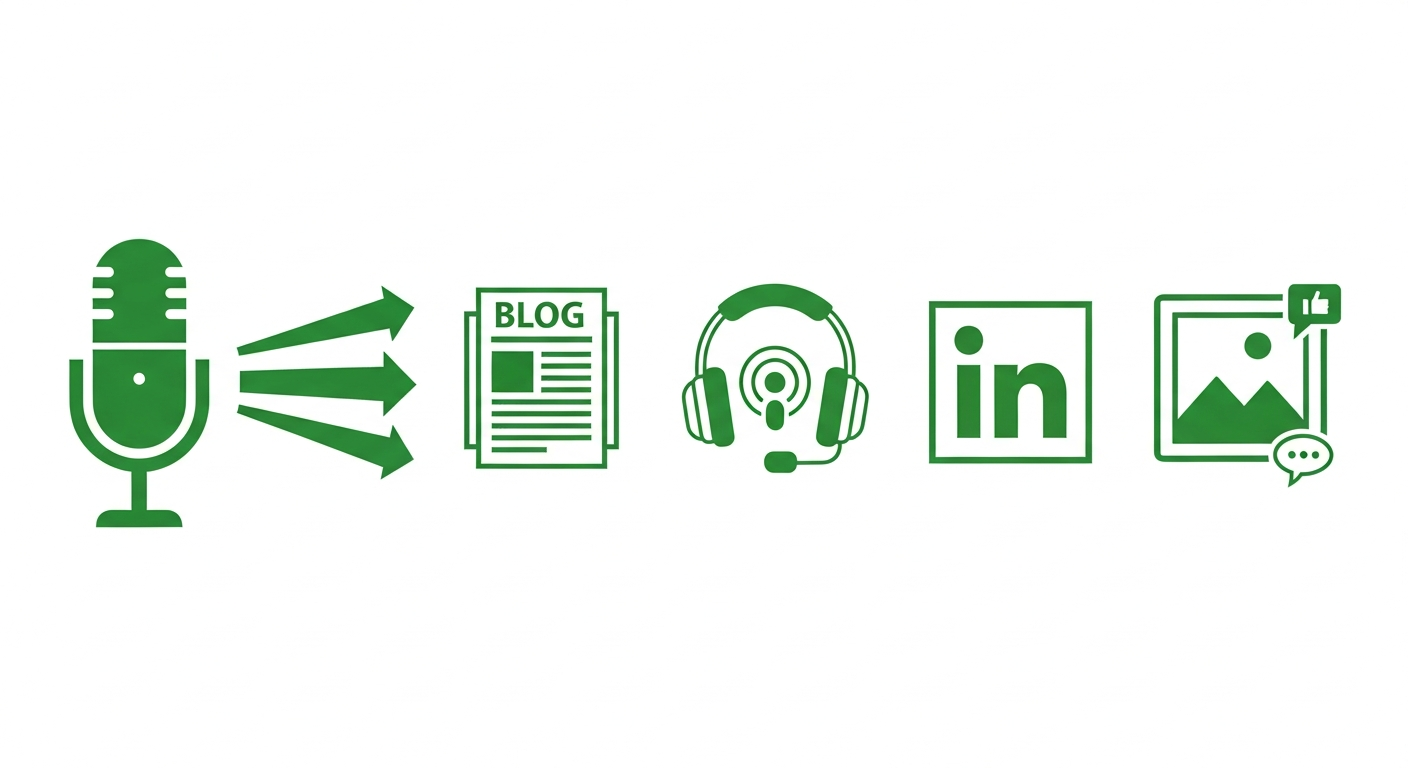
Here's what a single recording turns into through Patric AI:
A blog article. Your five-minute recording becomes a formatted, readable blog post that you can publish directly to your website. Over time, these articles build organic search traffic — each one is an additional page Google can index, an additional answer your ideal customer might find when searching for help with a problem you solve. Small businesses are 23% more likely than average to see ROI from blog posts, according to HubSpot's 2026 State of Marketing Report.
A podcast episode. Your recording becomes a podcast episode that can be distributed to Spotify, Apple Podcasts, and other platforms. Even a short, five-minute episode is a legitimate podcast format — many of the most successful business podcasts are deliberately short because their audience is time-poor. As covered in how to deliver a compelling solo podcast episode, the length matters far less than the value inside it.
Social media posts with graphics. Your recording generates ready-to-share posts and platform-specific graphics for LinkedIn, Facebook, Instagram, and X. Instead of staring at a blank caption field trying to think of something interesting to post, you have pre-drafted content pulled directly from what you said, formatted for each platform.
Five minutes of genuine expertise, distributed across four marketing channels. Ten minutes, and you have a 2,000-word article that would have taken three hours to write. That's the exchange rate.
---
The One-Recording-Per-Week Workflow
The goal is to make this so simple that it happens every week without requiring any significant planning, willpower, or creative energy.
Here's the full workflow:
Pick one question your customers ask you regularly. Every business owner has a short list of things customers ask constantly. "How much does it cost?" "How long does it take?" "What's the difference between X and Y?" "How do I know if I need this?" These questions are content gold because they represent real things real people want to know — and real search queries.
Set a timer for five minutes and record yourself answering it. Don't write a script. Don't plan it out. Just talk the way you'd talk if a customer called you right now. Upload the audio file through the Patric AI website or record directly using the website widget.
Let Patric turn it into your week's content. Your blog article, podcast episode, and social media posts are generated automatically. Review them, make any small edits you want, and publish.
That's the entire workflow. The recording is the only step that requires your original thinking. Everything else is handled.
!A simple weekly habit — one recording, once a week, is all it takes

Most business owners find that five minutes is actually too short once they start talking — they end up recording eight or ten minutes without trying. That's fine. Longer recordings produce richer content. But the five-minute minimum removes the pressure of having to produce something substantial. Even on the busiest week, most people can find five minutes.
---
What To Talk About (When You Don't Know What To Say)
The most common objection to this strategy is "I don't know what to talk about." In reality, the problem is usually the opposite: too many options and no clear starting point.
Here are five starting points that work for almost any small business:
Answer a question a customer asked this week. If a customer asked you something — by phone, email, or in person — that's a signal that other potential customers have the same question. Record yourself answering it. This type of content is inherently useful because it's pulled directly from real demand.
Explain something most customers get wrong. Every industry has common misconceptions. Plumbers know customers believe certain DIY fixes that make problems worse. Accountants know clients misunderstand which expenses are deductible. Coaches know prospective clients have unrealistic timelines. Correcting a misconception is one of the most effective content formats because it demonstrates expertise and earns trust simultaneously.
Walk through a recent project or client win (without names if needed). Describe the situation, the challenge, what you did, and the outcome. This format builds credibility in a way that feels authentic rather than promotional. As explored in why you should interview your best customers on a podcast, real stories from real client situations consistently outperform generic tips.
Share your opinion on a trend in your industry. What's changing in your space? What do you think about it? Your perspective — even on a well-covered topic — is unique because no one else has your combination of experience, clients, and point of view. The authenticity advantage in content marketing is real: your genuine voice is one thing AI-generated content cannot replicate.
Describe the most important thing a new customer should know. If someone was about to hire you for the first time, what's the single most useful thing they should understand about working with you, the process, or the outcome? Record that answer.
For a deeper dive into this topic, check out the 20 audio ideas for real estate agents article for a concrete example of how this brainstorming process works in a specific industry. The same approach applies regardless of what you do.
---
Why Consistency Beats Volume Every Single Time
One of the most important data points in content marketing research is this: 83% of marketers believe it's more effective to publish higher-quality content less frequently, according to Content Marketing Institute research. Quality and consistency matter more than sheer volume.
This is excellent news for small business owners operating at the minimum viable level.
Publishing one genuine, useful five-minute recording per week — 52 pieces of content per year — dramatically outperforms a burst of activity followed by months of silence. Search engines reward consistent publishing. Social media algorithms reward consistent activity. And perhaps most importantly, audiences build habits around consistent creators.
91% of the most successful B2B marketers consider content consistency to be an important factor in their strategy. Not volume. Consistency.
The business that shows up every week with one useful piece of content will outrank and out-trust the business that publishes twenty posts in January and then disappears. This is a race that rewards showing up, not sprinting.
Content marketing is compounding. Each piece of content you publish is a permanent asset that continues working for you. Blog articles remain in search results and attract traffic for years after publication. A social media post fades within hours. A podcast episode gets discovered by new listeners months after it was recorded. The more consistent your publishing, the larger the permanent asset base you're building.
Consistency also solves the cognitive burden problem. When content creation is a weekly habit — like opening your inbox or reviewing your accounts — it stops feeling like a special project and becomes just part of how the business operates. The decision fatigue of "should I do this today?" disappears because the answer is always yes, it happens every week.
---
The Compounding Effect: What Happens After 12 Months
The minimum viable strategy seems modest when you start. One recording, once a week. By the end of the first year, it's anything but modest.
After 52 weeks at one recording per week, here's what you have:
!Content compounds steadily — each recording adds to a growing permanent asset base

52 blog articles on your website. Each one is indexed by Google. Each one targets specific questions and keywords your potential customers are searching for. The cumulative traffic from 52 useful articles is dramatically higher than from five or ten. Websites with blogs have 434% more indexed pages than those without, and each new page compounds on that advantage.
52 podcast episodes in the directories. Your podcast has a genuine back catalogue. New listeners who discover you through a single episode can explore 51 more. The trust built through a consistent audio presence over 12 months is significant — listeners who follow a podcast for that long become some of a business's most loyal customers.
200+ social media posts with graphics. Four platforms, fifty-two weeks. That's a consistent, professional social media presence across LinkedIn, Facebook, Instagram, and X — without a social media manager and without spending hours every week creating content.
A recognizable, trusted voice in your market. The cumulative effect of showing up consistently in multiple places over a full year is brand authority. People who've read your articles, heard your podcast, and seen your social posts develop a sense of knowing you before they ever reach out. When they're ready to buy, you're the obvious choice.
All of this from five minutes per week.
---
Common Objections (And Why They Don't Hold Up)
"My voice isn't polished enough for a podcast or audio content."
The research says otherwise. Audio-only content like podcasts builds stronger trust with listeners than polished video for a simple reason: it feels more personal. The conversational, slightly imperfect quality of genuine spoken content is a feature, not a bug. Listeners connect with real people, not broadcast performances. As discussed in why raw podcasting works, authenticity outperforms production quality for building audience trust.
"I don't have anything interesting to say."
You run a business. You have customers with problems you solve. You have expertise that took years to develop and that your customers can't replicate. The gap between what you know and what your potential customers know is your content. You don't have to be entertaining — you have to be useful.
"I tried content marketing before and it didn't work."
If previous content marketing efforts didn't produce results, the most likely explanation isn't that content marketing doesn't work for your type of business — it's that the effort was inconsistent or concentrated in one channel. Content marketing requires sustained effort over months before it shows significant results. The advantage of the minimum viable approach is that it's sustainable enough to actually run for the months required to see the payoff.
"I'm already too busy."
This objection deserves to be taken seriously. If your business genuinely cannot spare five minutes per week, something else needs to change — either the business is understaffed, or the five minutes need to come from somewhere else (driving to a client, waiting for a meeting, walking between tasks). Most business owners spend more than five minutes per week on activities that produce zero marketing value. The question isn't whether you have five minutes; it's whether you're willing to redirect five minutes toward something that compounds.
"I'm not sure what to record."
Start with the question a customer asked you most recently. That's it. That's your first recording. Don't overthink the strategy before you've proven to yourself that the habit is sustainable.
---
Frequently Asked Questions
How long should my recordings actually be?
Five minutes is the minimum suggested here, but the sweet spot for most business owners is ten minutes. At a natural speaking pace, ten minutes produces around 1,300 spoken words — enough for Patric AI to generate a fully structured 2,000-word blog article, a complete podcast episode, and a full set of social media posts. That's the equivalent of what most people would spend two to three hours writing from scratch. Recordings can run anywhere from three minutes to twenty minutes and still work well. Shorter recordings (three to seven minutes) are excellent for focused, single-topic content. Longer recordings (ten to twenty minutes) work well for deeper topics. What doesn't work well is forcing a topic into an arbitrary length — record until you've said what you wanted to say, then stop.
Do I need any special equipment to record?
No. Your phone's built-in microphone is completely adequate for voice-to-content recording. The audio quality matters for pleasantness, not functionality. You can improve quality by recording in a quiet room and holding the phone about six inches from your mouth, but you don't need a microphone, a quiet studio, or any additional hardware. Check out how to record high-quality audio using just your phone for a practical guide if you want to optimize without spending anything.
What if my topic is too niche for anyone to care about?
Niche is good. Niche topics attract smaller but more qualified audiences — people who are specifically looking for what you offer, not casual browsers. A local plumber talking about common pipe problems in older homes in their specific city reaches exactly the people who need a local plumber. A narrow topic that's deeply useful to the right audience consistently outperforms broad content that's mildly relevant to everyone.
How long before content marketing produces real results?
Realistically, three to six months for initial traction, and twelve months for significant compounding results. Research by Semrush found that 39% of marketers report AI-generated and AI-assisted content taking around two to three months to rank in search results. Organic search is a slow-build channel — that's also why it's one of the most durable. Paid advertising stops the moment you stop paying. Blog content, podcast episodes, and consistent social presence continue producing results long after you've moved on to new content.
Can I use this strategy alongside other marketing I'm already doing?
Absolutely. The minimum viable approach is designed to slot into an existing schedule without displacing anything. If you're already running paid ads, doing networking, or working referrals, five minutes of weekly recording stacks on top of those efforts rather than competing with them. Over time, the organic presence you build through consistent content often reduces dependence on paid traffic and referrals alone.
What's the biggest mistake to avoid?
Treating the first recording as a test run rather than publishing it. Many business owners record their first piece, decide it wasn't good enough, and never publish. This is the wrong instinct. Publish the first recording. It will be imperfect. That's fine. The goal of the first recording is to prove to yourself that you can do it and that the system works — not to produce your best content. Your best content will come after months of consistent practice, not on your first attempt.
---
Five minutes a week. One recording. A blog article, a podcast episode, and social media posts with graphics — automatically.
That's the minimum viable content marketing strategy. It's not glamorous. It won't make you viral overnight. But it will build a compounding content asset that attracts customers, establishes your authority, and works for you long after you've stopped thinking about it.
Ready to start? Record your first five minutes at Patric AI — no writing, no editing, no video required.